Online shopping has made it easier than ever to compare products, discover deals, and find attractive discounts from thousands of stores. However, not every sale price represents genuine savings. Some online retailers promote misleading discounts by increasing the original price before applying a markdown, displaying inflated “regular prices,” or using urgent sales messages to encourage shoppers to buy quickly. This makes knowing how to spot fake discounts and inflated prices online an important skill for every modern shopper.
Consumers searching for the best online deals, genuine discounts, real price drops, shopping coupons, promo codes, and lowest product prices should look beyond the percentage displayed on a product page. A product marked “50% off” is not necessarily a bargain if its previous price was artificially increased. By learning how online pricing works and checking a few important details before checkout, shoppers can make smarter purchasing decisions and avoid misleading discounts.
Why Online Discounts Are Not Always Real
Discount labels are designed to attract attention. Terms such as “limited-time offer,” “huge savings,” “flash sale,” and “up to 70% off” can create a sense of urgency that encourages customers to purchase without comparing prices. While genuine promotions are common, the advertised percentage alone does not tell you whether you are receiving a good deal.
An online store may compare the sale price with a previous list price, manufacturer suggested price, or reference price rather than the price the product was actually selling for recently. This is why understanding the true selling price is more important than simply trusting a large discount percentage.
Check the Price History Before Buying
One of the most effective ways to identify an inflated price is to research how much the product has actually cost over time. A current “discounted” price becomes more meaningful when you know the product’s previous prices.
Price history tools and comparison websites can help shoppers track how product prices change over days, weeks, or months. If a retailer suddenly raises a product from a normal selling price and then applies a large discount, the promotion may look better than the actual savings.
Checking price history is especially useful for expensive products such as smartphones, laptops, televisions, cameras, home appliances, and other electronics where even a small pricing change can represent a significant amount of money.
Compare the Same Product Across Multiple Stores
Never assume that the first sale price you find is the cheapest available option. One of the simplest ways to spot a fake discount is to compare the exact same product across different online stores.
Search for the identical model number, product version, size, color, and specifications rather than comparing similar-looking products. A retailer may advertise a large percentage discount while another store sells the same item at a lower everyday price without using a large “sale” label.
Using online price comparison, marketplace searches, and manufacturer websites can help reveal whether a promotion is genuinely competitive or simply presented as a special deal.
Be Careful With Inflated Original Prices
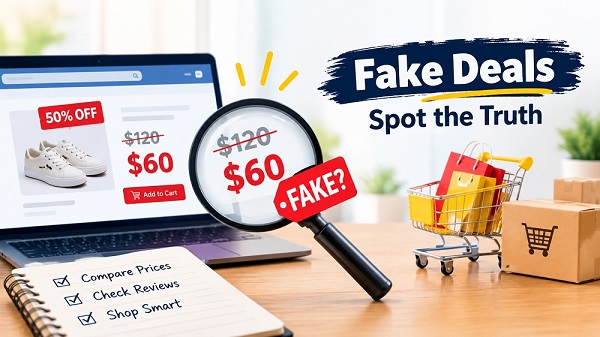
The original price shown next to a sale price can be one of the biggest clues when evaluating an online discount. A product listed as ₹10,000 and reduced to ₹5,000 appears to offer a dramatic 50% discount, but the important question is whether the product was genuinely sold for ₹10,000 before the promotion.
Some retailers use higher reference prices to make the discount look more impressive. Consumers should therefore focus on the current market price and recent selling history rather than the crossed-out amount alone.
When shopping for genuine discounts online, a realistic comparison price is far more useful than a large percentage printed next to the product.
Calculate the Final Checkout Price
A product can look heavily discounted while still being expensive at checkout. Shipping fees, service charges, taxes, handling costs, installation fees, and mandatory add-ons can increase the final amount significantly.
Always continue to the final checkout stage and review the complete price before deciding whether a deal is genuinely affordable. A product advertised with a 40% discount may end up costing more than a competing product with a smaller advertised discount but lower additional charges.
The final checkout price is the number that matters, not the percentage shown in the promotional banner.
Read the Terms Behind Flash Sales and Limited Offers
Flash sales and countdown timers are powerful marketing tools because they create urgency. A message suggesting that only a few products remain or that a discount will disappear within minutes can encourage impulse buying.
Some limited-time promotions are genuine, but shoppers should still compare the price before purchasing. A countdown clock does not automatically mean the product is available at its lowest price.
Take a moment to check other sellers, recent prices, coupon codes, and product reviews before committing. Avoid making expensive purchases simply because an online store suggests that the offer is about to expire.
Check Coupon Codes Before Paying Full Price
A product may already have a sale price, but an additional coupon code or promotional discount could reduce the total even further. Before completing your purchase, search for current promo codes, cashback offers, free shipping promotions, and first-order discounts.
This is particularly useful when shopping from large eCommerce platforms, fashion retailers, travel websites, software providers, and electronics stores. A store’s advertised sale may not be its only available promotion.
Combining a legitimate sale with an applicable coupon or cashback offer can provide more meaningful savings than relying solely on the headline discount.
Watch for “Up to” Discount Claims
Phrases such as “up to 80% off” can be misleading because the highest discount may apply to only a small number of products. Most items in the sale could have considerably lower discounts.
Instead of assuming that an entire category is heavily discounted, check the exact percentage attached to the product you want. A category-wide banner may advertise an impressive maximum discount while the item you actually want is discounted by only a small amount.
Understanding the difference between “up to” discounts and actual product discounts can prevent unrealistic expectations when shopping online.
Compare Product Specifications Along With Prices
A lower price does not always mean better value. Retailers may sell different versions of what appears to be the same product, with differences in storage capacity, model year, size, included accessories, warranty, or technical specifications.
Before declaring a product a bargain, verify that you are comparing the same model and configuration. A cheaper smartphone with less storage or an older model may appear to offer a bigger discount while providing less value.
Smart online shopping means comparing price, quality, specifications, warranty, and included features together.
Look at Reviews and Seller Reputation
Fake discounts are not the only risk in online shopping. A low price can sometimes be connected to poor-quality products, unreliable sellers, counterfeit items, or unclear return policies.
Reading recent customer reviews and checking seller ratings can provide useful information before making a purchase. Pay particular attention to reviews mentioning product authenticity, delivery problems, refund issues, or differences between the advertised product and what customers actually received.
A genuine discount is only useful when the product and seller are trustworthy.
Understand Seasonal Sales and Pricing Patterns
Major shopping events such as Black Friday, Cyber Monday, festive sales, end-of-season clearances, and anniversary promotions can create genuine opportunities for savings. However, not every product reaches its lowest price during every major shopping event.
Retailers often promote products based on inventory and demand, so some items may be discounted more heavily during one season than another. Keeping track of normal prices throughout the year helps shoppers recognize when a sale is truly attractive.
Building the habit of checking prices before major shopping events can make it easier to separate real bargains from marketing hype.
Smart Online Shopping Means Looking Beyond the Discount Tag
The most important lesson when shopping online is that a large discount does not automatically equal a good deal. A genuine bargain should be evaluated using the current market price, recent price history, product specifications, seller reputation, shipping charges, return policy, and final checkout total.
Consumers who take a few extra minutes to research products are much less likely to fall for inflated prices or misleading promotions. They are also more likely to find authentic online shopping deals, coupon discounts, cashback offers, and genuine price reductions that provide meaningful savings.
Final Thoughts
Learning how to spot fake discounts and inflated prices online can help shoppers save money and avoid unnecessary purchases. The biggest mistake is focusing only on the percentage displayed beside a product. Instead, compare prices across multiple stores, check price history, review the final checkout amount, investigate coupon codes, and confirm that the product specifications match what you actually need.
Smart shoppers understand that the best online deal is not always the one with the biggest discount label. It is the offer that provides the right product at a genuinely competitive price with clear terms and trustworthy service. By developing better price-checking habits and researching before checkout, you can avoid misleading sales, identify real bargains, and make every online purchase more rewarding.


 0
 0


